

Composite scenario
Family holdings and the business: separating functions before deciding
Two related functions of the holdings, to be made legible.
Over time, the properties used by the business can become a significant part of the family holdings.
Warehouses, offices, land and operating properties grow together with the business. The closeness between holdings and business can create efficiency, but it makes it necessary to understand precisely what function each asset performs.
This scenario shows how a structure that has grown organically can be reread before a new investment, a financing or an intergenerational transfer.
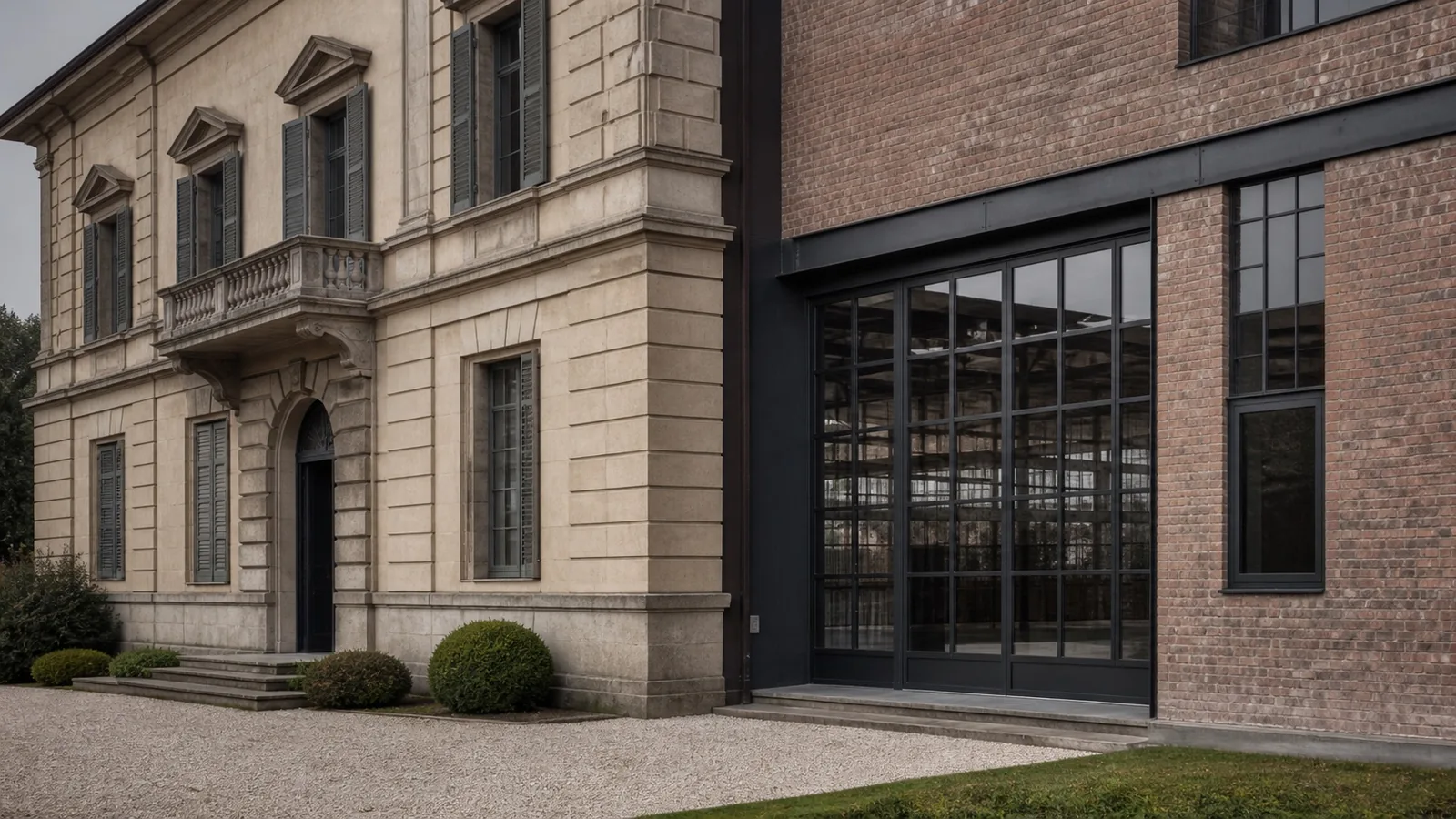
The situation
The situation
A family business uses several properties:
- the head office, owned directly by the family
- a production building registered to a property company
- a warehouse bought by the operating company
- an adjoining plot of land earmarked for possible expansion
- some properties pledged as security to finance the development of the business.
This configuration effectively supported the growth of the business. Over time, however, the functions of the assets have become less distinguishable.
The family is considering a new productive investment. At the same time, the handover of the company's management to the next generation is approaching.
The functions
One structure, different functions
A property used by the business can perform several roles at once:
- housing production
- serving as financial security
- generating income for the family
- forming a reserve of wealth
- offering capacity for expansion
- becoming, over time, an asset that can be repurposed or transferred.
When these functions remain implicit, every new transaction can also alter the balance within the family.
A company financing can involve a property intended for the continuity of the holdings. A corporate reorganisation can reduce future flexibility. A division among heirs can separate ownership of the property from the responsibility of the person running the business.
The method
The reading through the Codes
1 Control
Who decides on the use, the repurposing or the sale of the strategic properties? Do ownership and operational responsibility point in the same direction?
3 Structure
Which assets belong to the industrial logic of the business and which to the wealth logic of the family? The distinction makes it possible to assess each property for the function it should perform over time.
4 Leverage
Which properties support the debt of the business? Does the system of guarantees keep a consistent relationship between the risk taken on and the expected benefit?
5 Exit
Does the structure make it possible to sell the business, transfer a property or separate a branch of the family while preserving operational continuity?
7 Continuity
Will the next generation receive a structure they can understand? Will roles, contracts, guarantees and the relationships between ownership and use remain legible in the future too?
The direction
The direction that emerges
The judgment leads to classifying the properties by their prevailing function, while also making explicit the secondary functions and the dependencies with the rest of the system:
- properties indispensable to production
- properties that are functional but replaceable
- wealth assets made available for the business to use
- properties intended for development
- assets that can retain an independent function for the family.
This distinction makes it possible to assess financing, guarantees, rents, investment and generational transfers with greater precision.
The decision on productive expansion thus enters a structure able to support both the business and the holdings at once.
The role of NEUTRAX
The role of NEUTRAX
NEUTRAX builds a unified reading of the properties connected to the business and the family.
The work clarifies function, control, dependencies, guarantees and future possibilities. The resulting picture allows the entrepreneur and the professionals involved to design the instruments from a direction for the holdings that has already been defined.
A first step
Are the business and the holdings growing together?
The first step is to identify which properties support the business, which protect the family and which perform both functions.
Five questions, three to five minutes, to frame the decision and the possible next step. Any engagement is assessed and formalised separately.
Composite scenario based on recurring configurations in real estate holdings connected to a business. It is for illustrative purposes.